
Scoring which processes pay before you invest

The durations come from the people who do the work
Most automation backlogs arrive ranked by irritation. The workshop that produced them asked which processes annoy people, and that is a different question from which ones pay. Irritation is real, but it is not a unit anyone can measure or plan with. What we run instead starts with the tasks themselves, recorded or surfaced before anyone is asked for an opinion, because a workshop held before the tasks are collected produces opinions instead of a list.Collecting the tasks with their durations before the ranking session is the whole method. The hours come from the people who do the work, not from the people who budget for it. Every task then carries three measurements and six suitability criteria, the session ranks hours per month against the total, and exactly five tasks leave the room with a data sheet each. There are two ways to start, and the engagement decides which one.
Two ways in
The discovery pass has two entry points, and the size of the engagement decides which one.
Systems-first. When everyone who performs the recurring work fits in one room, the work is read out of the systems that already hold it: the ticket queue, mailboxes and shared calendars, business apps, and the spreadsheets that have become databases. One session with the whole office and management confirms frequency and effort. This is the cheaper door, and it works when the recurring work is visible in those five places. A business whose recurring work lives on paper and in phone calls needs the other door regardless of its size.
The recording week. When a sponsor is speaking for teams who are not there, nobody in the room can give the durations. Everyone doing the recurring work records their own tasks for one week: part-time staff, assistance, accounting and dispatch included, entered in a workbook that totals hours per month while typing, with a printable one-page grid for anyone on paper. Then roughly 45 minutes of scoring per person and a 60-minute consolidation.
The rule underneath both doors is the same: whoever performs a task knows how long it takes. What changes is how that knowledge gets into the room. The recording week is not an extra step for bigger customers; it is the substitute for a room that cannot hold everyone. And the systems-first discovery is not a shortcut; it is the direct path, available whenever the room can verify what the systems show.
Either way, what leaves the discovery step is a list of recurring tasks with durations attached. Those durations were given by the people who do the work, and that is the only reason the numbers that follow are worth ranking.
Three measurements, one unit
Each task on that list carries three measurements: how many minutes a single run takes, how many runs happen per month, and the follow-up effort behind each run. All three resolve to hours per month. That is the unit every later step is denominated in, and it is worth getting right here, because a baseline set during a workshop is an estimate agreed in a room rather than a figure anyone counted.
Minutes per run is the number people overestimate most, because they remember the run that took the longest. Follow-up effort, the time spent checking, handing off or correcting after the main task finishes, is the one they forget entirely. If a task takes ten minutes to execute but thirty minutes to verify, it is a forty-minute task, and the criteria that follow need all forty.
Hours per month alone do not decide. A task running 80 hours a month sounds urgent until the criteria show it carries a consequence of error that puts a review step into the hours. The hours set the scale; the criteria set the shape.
Six criteria, a total out of thirty
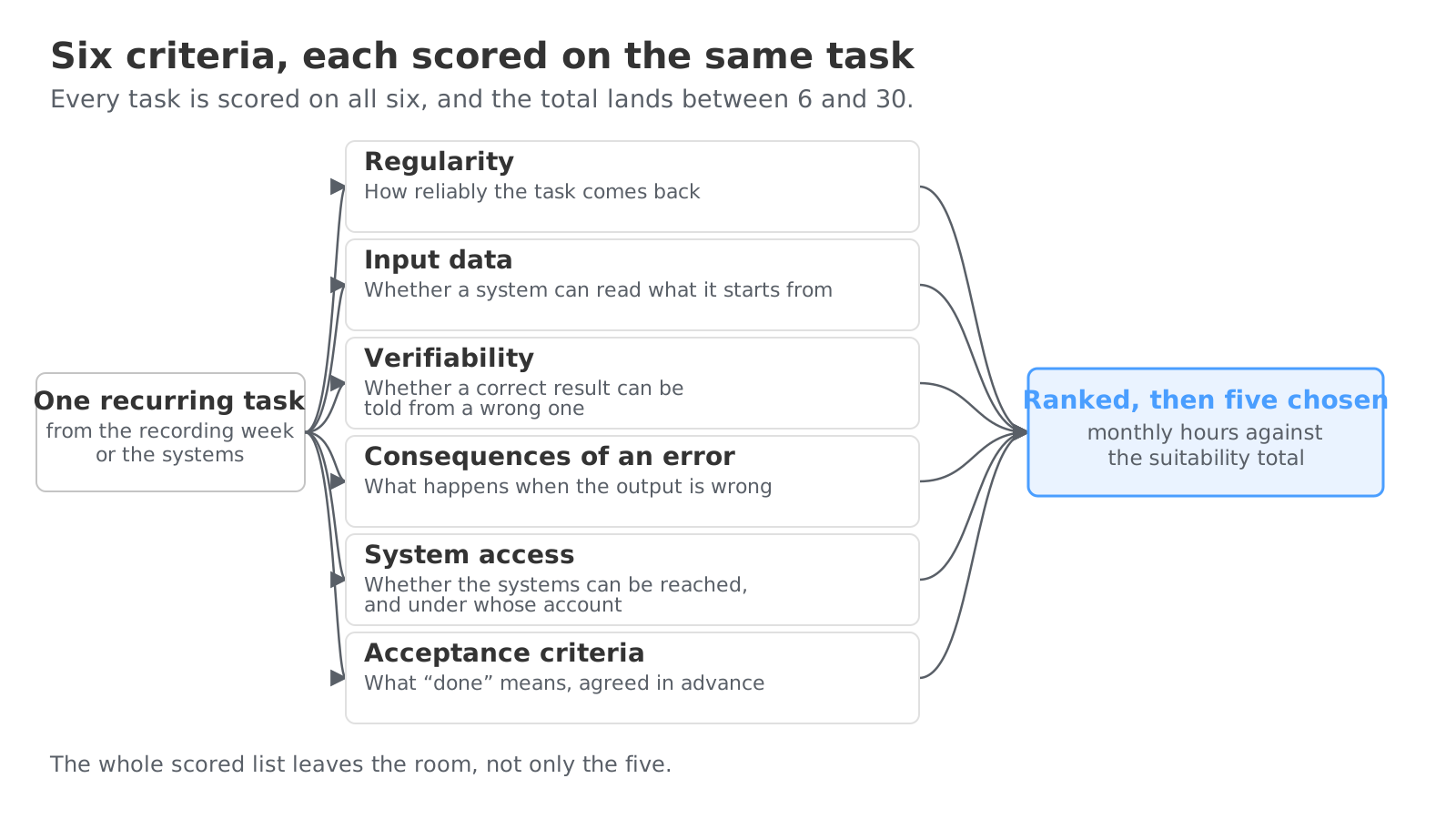
We score every task on six suitability criteria: regularity, input data, verifiability, consequences of an error, system access, and acceptance criteria. The total lands between 6 and 30.
The one that reorders the list most is consequences of an error. A wrong result that triggers a credit note or a regulatory question costs more to contain than the automation saves, and that cost belongs in the same arithmetic as the saving. We flag tasks touching personal data for review rather than excluding them, because excluding them by default removes most of the real work. The DSGVO and EU AI Act check runs inside this same pass, over the systems already in production, and the risk tier is classified before any approach is chosen for it.
The session that settles on five
The ranked list is already on the table when the room sits down. We rank monthly hours against the suitability total, and the session settles on exactly five processes.
Who is in that room follows from the door. Behind the systems-first entry: the whole office and management. Behind the recording week: the participating teams and their sponsor. Either way, the people who gave the durations are present when the selection is made, and that is not ceremony; it is the reason the five that get chosen hold up when the work starts.
Duplicates are a signal, not an error. A task two people named independently is usually the one worth solving first, because two reports of the same work confirm both the hours and the friction.
Five is not a quota. The session might pick three. A low suitability total is a result, not a wasted pass: the same four artifacts leave the room either way, and nothing is bought, installed or migrated during the whole pass. What the buyer walks away with is a decision, not a commitment.
The data sheet and what survives the year
Each selected task gets a data sheet: who performs it, who accepts the result, the current hours per month with the date and source of that figure, whether it was measured or estimated, and a target in the same unit.
One field deserves its own sentence: “who accepts the result.” A task without a named acceptor has no standard to check against. We name the acceptor during the pass, because an automation built without one delivers output nobody checks against a standard.
The baseline distinction matters just as much. A measured figure is compared against a measured remeasurement; an estimate is compared against an estimate. Mixing the two produces a number that proves nothing, and that is why we record the method alongside the figure. We remeasure no earlier than four weeks after the work begins, by the same method. The number either moved or it did not, and the data sheet is the receipt.
What leaves the pass is a fixed set: the scored list with one leading route per process, a data sheet per selected process with its baseline, the checklist set per stakeholder role, and the written DSGVO and EU AI Act position. Those four artifacts are the same whether five processes clear or none do.
Each selected task then gets its leading route from a nine-question decision path, first match winning. The questions ask where the task already lives, not which product sounds right, and the routes name what the task needs rather than what the catalogue offers. Choosing the tool before understanding the task is the mistake this pass exists to prevent. Nothing is installed, nothing is migrated, and the five tasks on the table have numbers attached that survive the year. The value discovery pass describes each step from the first session to the signed data sheet.